What the Walls Remember: Inside the Private World of American Family Home Photography
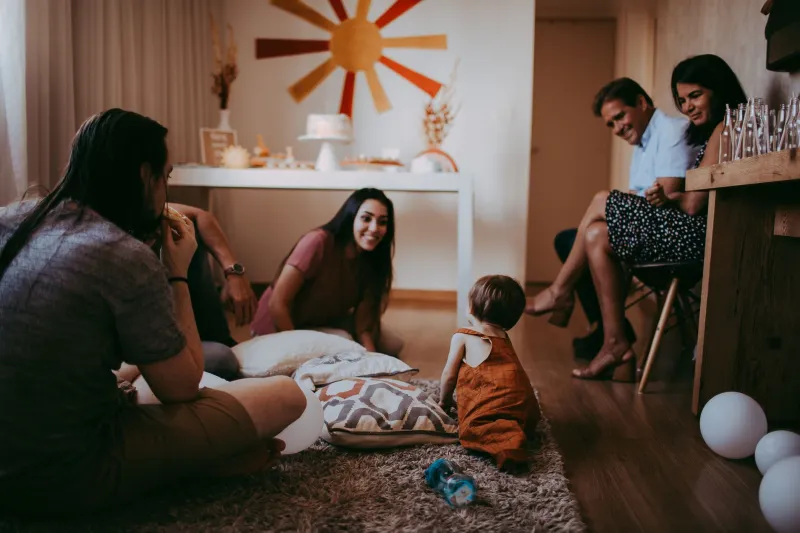
There is a particular kind of photograph that cannot be made in a studio. It requires a living room with afternoon light falling at an impractical angle, a dog underfoot, a toddler who has lost interest in posing, and a grandmother whose laughter is too large for the frame to contain. It requires, in other words, a home.
At SJM Photography, some of our most meaningful work has taken place not in controlled environments but in the domestic spaces where American families actually live—where the walls hold crayon marks no one could quite bring themselves to paint over, and where every corner of every room is dense with the accumulated evidence of a life shared.
The Threshold Moment
Every home photography session begins with a threshold moment—the instant the photographer crosses from the public world into the private one. It is a moment that carries real weight. A family's home is not simply a location; it is a repository of identity. The objects on the shelves, the photographs already hanging on the walls, the particular way the light enters a bedroom window at three in the afternoon—all of these are part of the story.
Experienced photographers recognize this immediately. The instinct is not to neutralize the environment, to push furniture aside and create a clean backdrop, but rather to read the space as carefully as one might read a face. What does this room say about the people who inhabit it? Where does the light fall most honestly? Which corner of the kitchen has witnessed the most conversations?
These are the questions that transform a home session from a logistical exercise into something closer to portraiture of a place.
What Unguarded Spaces Reveal
The great gift of home photography is what it captures when no one is performing. In a studio, subjects arrive knowing they are there to be photographed. The awareness of the camera is ever-present, and even the most relaxed clients retain a degree of self-consciousness that shapes how they hold themselves, how they interact, what they allow themselves to feel.
At home, that self-consciousness has competition. The baby needs feeding. The dog needs attention. The teenager disappears into their room and has to be coaxed back out. The grandmother begins telling a story that nobody asked for but everyone needs to hear. Life continues around the camera, and the photographer's task is to be present enough to catch the moments that life produces.
What emerges from these sessions is often startling in its intimacy. A father helping his daughter with homework at the kitchen table. Two brothers in a disagreement that resolves itself in laughter within thirty seconds. A couple of forty years sitting in their usual chairs with the ease of people who no longer need to explain themselves to each other. These images carry a weight that no posed portrait can fully replicate.
The Generational Architecture of American Homes
Home sessions are particularly revealing when multiple generations share a space—or when a home has housed multiple generations over time. The physical environment of a family home accumulates meaning across years and decades in ways that become visible to a careful photographer.
The wedding photograph on the mantel that predates everyone currently living in the house. The quilt folded over the arm of the sofa that a great-aunt made. The height marks penciled on the doorframe of the kitchen, a vertical record of children growing up. These objects are not props; they are participants in the story the photographs are trying to tell.
In multigenerational households—which are increasingly common across the United States—the dynamic between grandparents, parents, and children creates a visual complexity that is endlessly rich. The way a grandfather holds a grandchild. The particular authority with which a grandmother occupies her kitchen. The way adult children navigate the space between their own autonomy and the gravitational pull of the home they grew up in. A skilled photographer can capture all of this without staging a single frame.
The Ethics of Intimacy
Photographing people in their homes carries ethical responsibilities that are worth naming directly. The access that a family extends to a photographer is a form of trust, and that trust must be honored with discretion and care.
At SJM Photography, we approach home sessions with a clear understanding that our role is to document, not to expose. There is a meaningful difference between capturing an authentic moment and intruding upon one. Experienced photographers develop a sense for this distinction—knowing when to raise the camera and when to lower it, when to stay present and when to step back.
This sensitivity is not just an ethical imperative; it is also what makes the resulting images trustworthy. When subjects know that the photographer is working with care and respect, they relax in ways that would otherwise be impossible. The camera becomes, over time, simply another presence in the room—one that the family has stopped performing for and started simply living alongside.
The Images That Outlast Everything
Families who have invested in home photography sessions often describe the resulting images in terms that go beyond aesthetic appreciation. They speak of what the photographs preserve: a particular stage of childhood that passed too quickly, a parent who is no longer living, a house that was later sold. They speak of showing the images to their children and watching their children see themselves as they once were.
This is the deepest argument for home photography. Studios produce beautiful images. But homes produce documents—records of actual life as it was actually lived, in all its imperfection and abundance. In a culture that increasingly values authenticity, these are the photographs that carry the most lasting weight.
The walls of an American home remember everything. A great photographer helps the family remember too.