When the 'Wrong' Shot Is the Right One: Embracing Imperfection in Professional Photography
There is a moment in nearly every professional photography session when the camera captures something unplanned. A subject turns their head a half-second too late. The light shifts unexpectedly. Laughter erupts before the pose is set. For many photographers, the instinct is to discard these frames immediately — to move past the technical anomaly and return to the clean, composed image that was envisioned from the start.
At SJM Photography, we have learned to pause before pressing delete.
The counterintuitive reality of visual storytelling is this: the photographs that move people most are rarely the ones that went exactly according to plan. They are the ones where something human slipped through.
The Myth of the Perfect Frame
American culture has a complicated relationship with perfection. From the curated grids of Instagram to the polished headshots that populate LinkedIn profiles, there is enormous social pressure to present a flawless version of reality. Photography, as a medium, has often been conscripted into that project — asked to smooth, to flatten, to idealize.
But here is what decades of visual research and the lived experience of professional photographers consistently confirm: viewers do not connect with perfection. They connect with truth.
A technically immaculate portrait — perfectly lit, perfectly composed, expression precisely calibrated — can feel like a mask. It communicates competence, certainly. But it rarely communicates character. And in the context of personal branding, where the goal is not merely to look professional but to be remembered, character is everything.
Motion Blur as Emotional Language
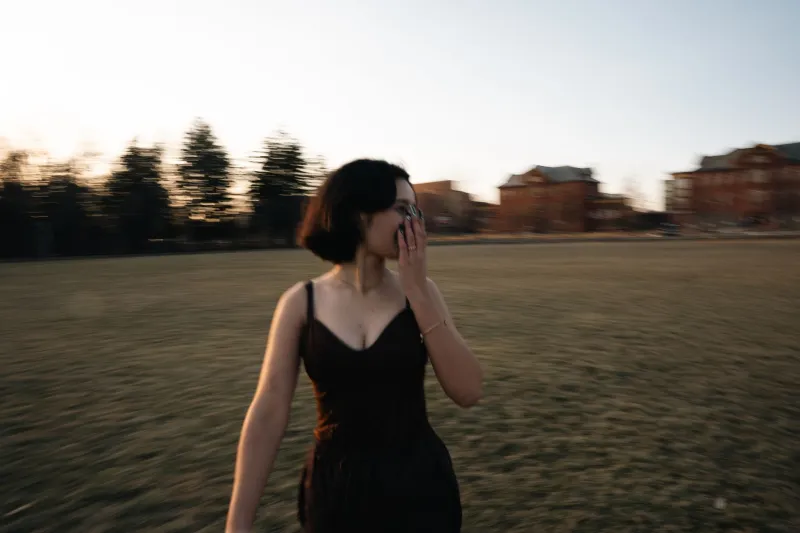
Consider the role of movement in photography. Conventional wisdom holds that sharp focus is non-negotiable — that any softness introduced by subject motion is a flaw to be corrected with faster shutter speeds and better technique. This is true in many contexts. But it is not universally true.
In one of SJM Photography's personal branding sessions with a Chicago-based entrepreneur, a frame captured the subject mid-gesture, hands slightly blurred as she leaned forward to make a point. Every other image from that session was pin-sharp. This one was not. Yet when the client reviewed the gallery, she returned to that single frame repeatedly. "That's actually how I am in meetings," she said. "That's the energy I want people to feel."
The blur was not a mistake. It was a document. It captured kinetic energy, forward momentum, the physical expression of a mind in motion. No perfectly still portrait could have communicated the same thing.
This is the distinction that separates a technical error from an expressive choice — not the presence of imperfection, but what that imperfection says.
Unconventional Framing and the Power of Negative Space
Classic compositional rules — the rule of thirds, balanced framing, subject placement within the frame's dominant quadrants — exist for good reason. They are codified expressions of how the human eye naturally moves across an image. Following them produces photographs that feel coherent and visually satisfying.
Breaking them, however, can produce photographs that feel alive.
In a personal branding portfolio SJM developed for a New York-based architect, one of the strongest images placed the subject far to the left of the frame, with a vast expanse of empty wall dominating the right side. By strict compositional standards, the image was off-balance. In context, it was a visual metaphor for the client's entire professional identity — someone who thinks in terms of space, who sees potential in emptiness, who designs around what is not there as much as what is.
The unconventional framing did not happen by accident, but it did happen intuitively, in a moment of instinct rather than deliberate calculation. Recognizing its value afterward required the willingness to look at the frame on its own terms rather than measuring it against a predetermined standard.
Raw Emotion vs. Managed Expression
Perhaps nowhere is the tension between perfection and authenticity more pronounced than in expressions. Professional portrait subjects are frequently coached — gently and with good reason — toward expressions that are open, confident, and approachable. These are genuine professional goals. But coaching can also produce a subtle artificiality, a slight stiffness that attentive viewers register even if they cannot name it.
The moments that escape coaching are often the most valuable.
A burst of genuine laughter captured before the subject has composed themselves. A flicker of vulnerability in the eyes during a pause between setups. The unguarded moment immediately after a long pose is released. These frames are frequently the ones that clients initially overlook in a gallery review, then circle back to with increasing conviction.
At SJM Photography, part of our process involves actively creating the conditions for these unguarded moments — not manufacturing them artificially, but building enough ease and trust within a session that they arise naturally. The technical discipline required to capture them when they do is considerable. But so is the editorial discipline required to recognize their value afterward.
Learning to Read Your Own Gallery
For clients reviewing a professional photography gallery, the practical implication of all this is straightforward: do not sort by technical perfection alone.
When you move through your images, pay attention to which ones make you pause. Notice which frames generate a physical response — a small intake of breath, a sense of recognition, a feeling that the image is somehow more you than the others. These responses are data. They are your nervous system registering authenticity.
Then ask a second question: why does this image resonate? Sometimes the answer will be that it is simply the best-composed, best-lit frame in the set. But sometimes — more often than you might expect — the answer will be that something unexpected happened, and the camera caught it.
That unexpected thing is worth more than a dozen technically correct alternatives.
The Photographer's Role in Recognizing the Unexpected
None of this is to suggest that technical skill is unimportant. The ability to control light, manage focus, and compose with precision remains the foundation upon which all meaningful photographic work is built. Imperfection that emerges from carelessness is simply carelessness. Imperfection that emerges from a session conducted with full technical command is something else entirely — it is the human element finding its way through.
At SJM Photography, the commitment to capturing moments that last a lifetime is not a commitment to capturing moments that look perfect. It is a commitment to capturing moments that are true. Sometimes those two things align. Sometimes they do not.
When they do not, we have learned to trust the truth.
The photograph you almost deleted may be the one that defines how you are remembered.